

Prosperity begins with opportunity - and opportunity is shaped by how innovation serves people, markets, and communities.
LINC-R Lab is our dedicated innovation and learning platform for designing, testing, and scaling solutions that strengthen livelihoods, expand inclusive economic participation and build resilience across emerging markets.
The Lab brings together our experts in research, technology, design, and development practice to explore how emerging technologies and new delivery models can address real-world challenges faced by underserved populations. By combining deep sector expertise with practical experimentation, we develop and test solutions that respond to the realities of micro-enterprises, smallholder farmers, households, and local economies.
Together with our partners, we apply structured innovation processes to explore ways to increase access to capital, markets, new technology for MSMEs, education, skills and employment for youth, and increased productivity for smallholder farmers.


-
We believe that innovation should expand opportunity rather than widen inequality. LINC-R Lab exists to ensure that new methodologies, technologies and systems create inclusive pathways to prosperity, particularly for those historically left behind.
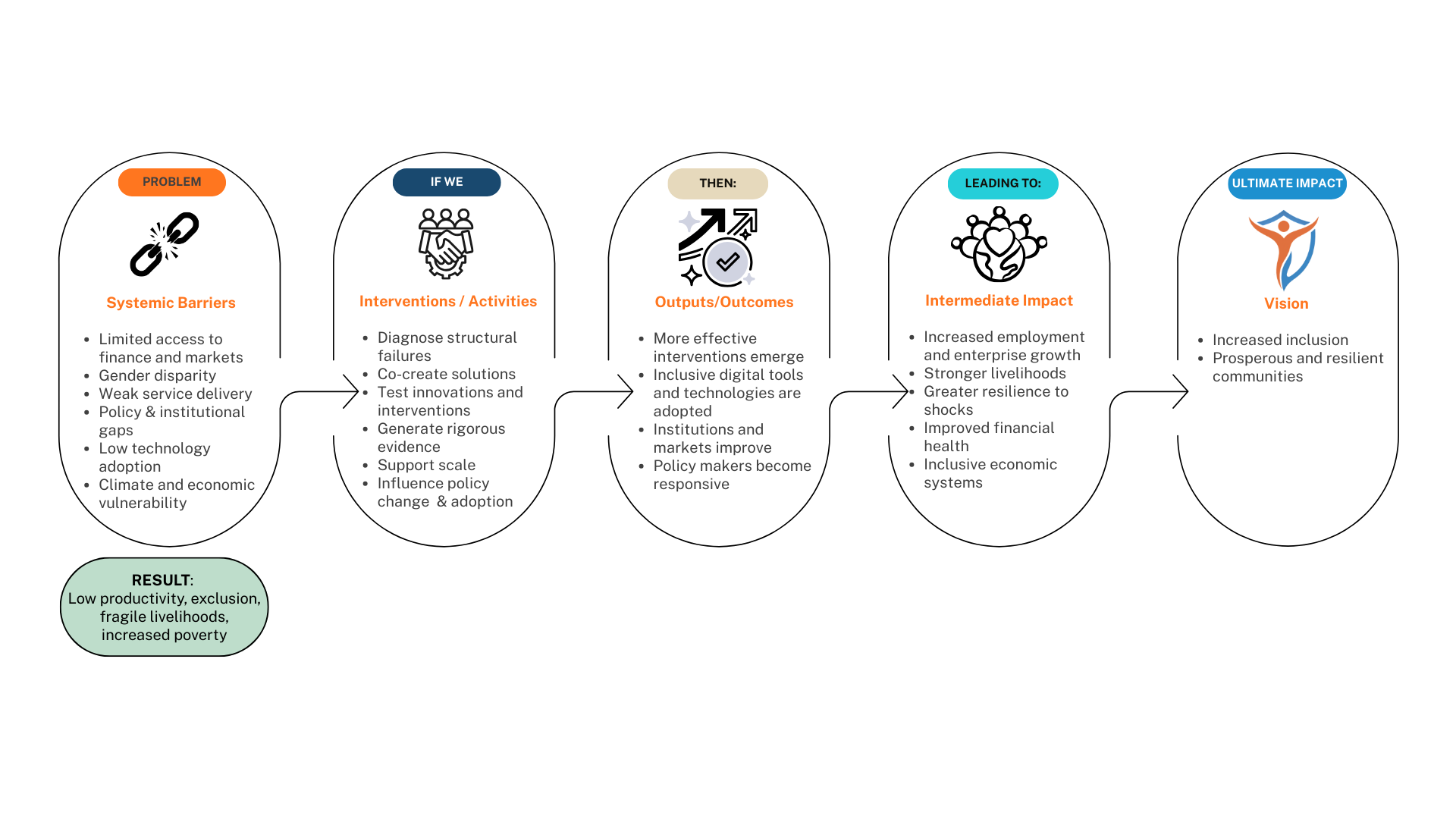
We bridge research, technology, and implementation to help partners design solutions that move communities from potential to prosperity, strengthening livelihoods, shaping inclusive futures and building resilience. See LINC-R Lab’s Theory of Change.
-
LINC-R Lab identifies and addresses the structural barriers that limit opportunity, resilience, and inclusive economic growth in emerging markets.
The Lab allows us to learn through simulation, test, play, scenario …and failure. We diagnose market failures, institutional constraints, policy gaps, and service delivery challenges that prevent underserved individuals and enterprises from accessing finance, markets, technology, and essential services.
We employ out-of-the-box thinking, combine innovation, research, and implementation to imagine, design and test practical solutions that strengthen systems and improve real-world outcomes. Our work focuses on closing access gaps, improving delivery models, enabling technology adoption, and strengthening the institutions and market ecosystems that shape livelihoods.
Through rigorous experimentation, rapid prototyping, and real-world testing, we develop and validate new approaches that improve financial health, economic participation, and resilience for vulnerable populations (micro-enterprises, smallholder farmers, and low-income households).
-
As a principle, the people in the communities we work in are our first partners in innovation. This is because they understand their needs better than we do, and often times have the solutions, just not in the way we see it.
Once we understand this clearly, we apply a ‘structured’ innovation process, building from our own insights and existing theories, to existing evidence for experimentation, to testing and implementation. Our team rapidly develops prototypes, conducts simulations, and refines solutions through continuous learning and engagement. This approach enables partners to explore new ideas with confidence and move quickly from concept to impact.
We leverage emerging digital platforms and financial technologies, artificial intelligence, and data analytics, applying them to real human contexts to improve efficiency, access to services, strengthening economic systems, and enhancing resilience.
We do this by:
Discovering how thing currently work
Developing new and alternative methodologies, including technology-enabled solutions for market access and enterprise growth
Designing and testing new and alternative models for inclusive finance and digital services
Building prototypes and pilot interventions for development programs
Testing delivery models that strengthen resilience and economic participation
Generating evidence on how innovation improves livelihoods and systems
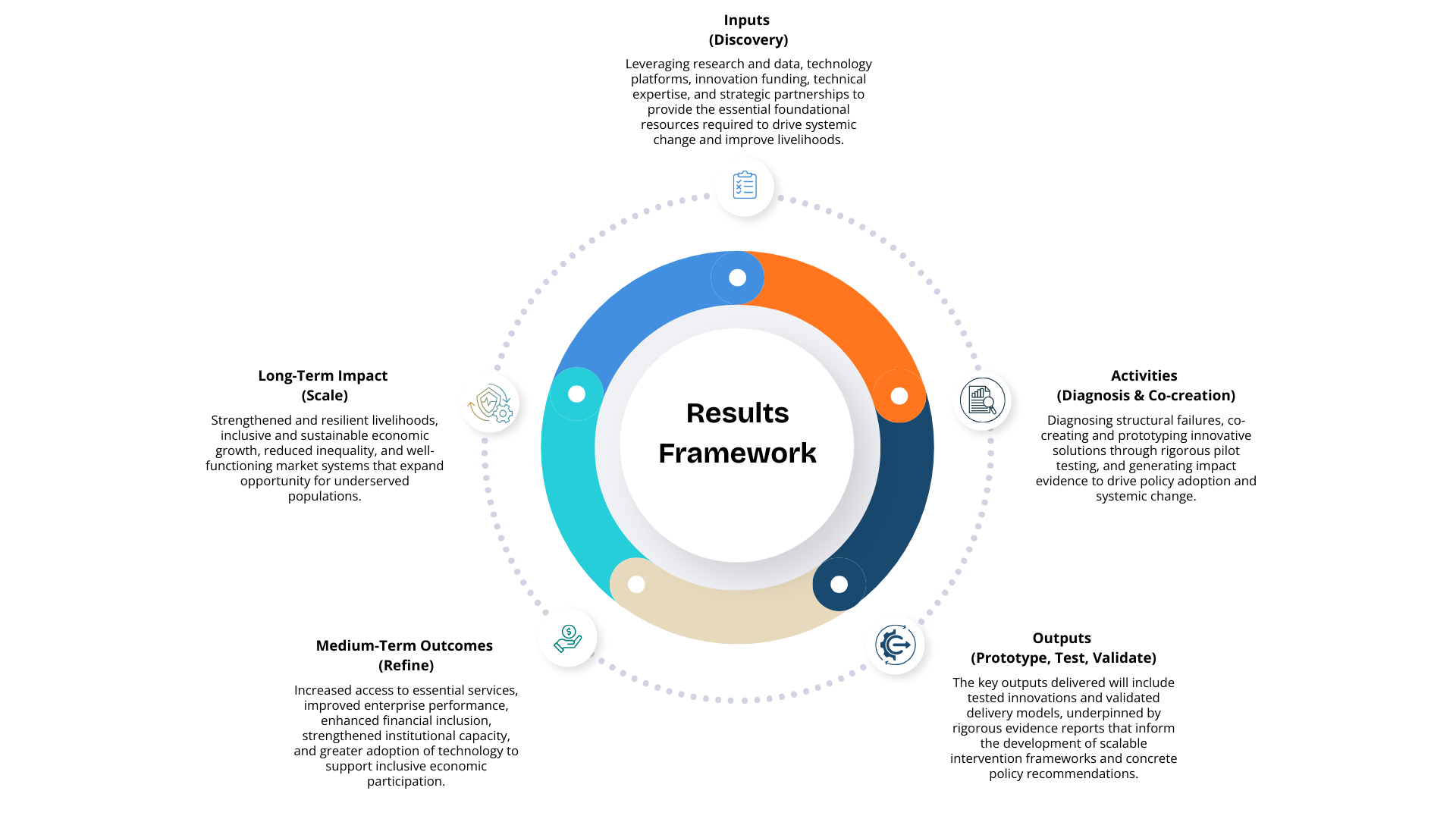
Through iterative testing and evidence generation, we ensure solutions are practical, scalable, and aligned with local needs as outlined in LINC-R Lab’s Results Framework.
-
LINC-R Lab draws on Tola Group’s core areas of expertise to drive innovation across our areas of experience, learning and interest. Discover what we are cooking in our growing Centres of Excellence and reach out to partner with us!
Financial Health
Our extensive work in driving access to digital financial services across Africa over the past decade has revealed the evolving face of ‘inclusion,’ shifting from account ownership to a more meaningful, safe usage that enhances welfare. Thus our aim is discover new ways that promote the shifts from access to effective usage, and from payments to financial health, particularly for the underserved segments (low-income households, rural smallholder farmers and micro-enterprises).
We are exploring new ways to design and strengthen digital payment ‘rails’ and financial products to reduce payment friction, high costs, consumer vulnerability so that digital payments systems become tools that support and improve financial health and consumer protection.
Digital Transformation & Readiness
Digital tools are only effective if the ecosystem is ready. Where there is a disconnect, participants from both the supply- and demand side become frustrated and great initiatives fail.
In this COE, we specialise in digital transformation strategies that align enabling infrastructure (connectivity and hardware) with human readiness (digital literacy and skills), with the aim of ensuring that the digital economy is a tool for mass participation, not exclusion. We use explorative research methodologies to uncover some of the common reasons for the disconnect, from system/product design, to using behavioural science to understand human interactions with technology.
Agriculture & Food Systems Resilience
Agricultural livelihoods are increasingly threatened by climate volatility and systemic shocks. Traditional interventions often focus on short-term coping mechanisms (incremental resilience) that fail to address the root causes of vulnerability, leaving communities unable to transition toward long-term, self-sustaining prosperity (transformative resilience).
We design strategies that move agriculture and community development along a continuum of resilience:
Incremental Resilience (Absorbing Shocks): Implementing climate-smart agricultural practices, improved seed varieties, and localized weather-information systems that allow farmers to withstand immediate environmental pressures without losing their primary assets.
Adaptive Resilience (Building Capacity): Strengthening value-chain optimization and market access to diversify income streams, ensuring that livelihoods can evolve in response to changing climatic and economic conditions.
Transformative Resilience (Systemic Change): Reshaping food systems through policy advisory, community-led development, and large-scale infrastructure investments that fundamentally alter the economic landscape, making high-productivity and sustainable growth the new baseline for vulnerable populations.
Livelihood Strengthening: Integrating sustainable environmental management with community economic development to ensure that resilience is built into the social and physical fabric of the region.
Micro, Small amd Small Entrepreneur Development and Support
Micro and small enterprises (MSMEs) in emerging markets often remain trapped in low-productivity, subsistence-level operations due to a ‘missing middle’ in infrastructure, finance, and market linkages. Without targeted intervention, these businesses struggle to add value to raw materials, access affordable growth capital, or navigate the complex regulatory hurdles of regional trade.
We seek to explore market-building interventions necessary for these enterprises to transition from subsistence to scale by exploring the following growth levers:
Access to Capital: Developing innovative credit-scoring models, startup financing, and working capital de-risking mechanisms to unlock affordable funding for MSMEs.
Value Addition & Industrialisation: Moving enterprises from raw commodity trading to processing and manufacturing, allowing them to capture higher margins and create local jobs.
Market Integration (Forward & Backward Linkages): Architecting partnerships that embed MSMEs into the supply chains of lead firms, securing reliable inputs and predictable off-take agreements.
Inclusive Trade (Local & Cross-Border): Identifying contributors to the high cost of doing business by advocating for simple regulatory compliance, facilitating affordable cross-border payments, and ensuring products meet international quality standards.
Operational Excellence: Addressing the ‘logistics tax’ through improved cold-chain, storage, and information systems that reduce waste and increase market transparency.
Women Economic Empowerment: Designing gender-intentional interventions that address specific barriers for female entrepreneurs, including access to networks, technology, asset-light financing, and the reduction of unpaid care burdens through tech-enabled solutions.
Theory of Change